BASIC TRAINING
3 DAYS
HAIR AUTOTRANSPLANTATION
BASIC TRAINING
For more than 14 years, doctors at the DEAMED clinic have been training physicians and assistants in the specialty “Hair Transplantation.”
Hundreds of students from dozens of different countries around the world have completed training at our clinic.
Basic training program in the specialty HAIR AUTOTRANSPLANTATION

HAIR AUTOTRANSPLANTATION
The “DeaMed” clinic is a university clinic where, within the framework of postgraduate medical education, qualification and training programs are carried out in the specialty “Hair Autotransplantation.”
The head and author of the training is plastic surgeon, Doctor of Medical Sciences, DIANA PAPASKIRI:
- - Member of the “International Society of Hair Restoration Surgery” (ISHRS, USA).
- - President of the “Georgian Society of Hair Restoration” (GSHR).
- - Member of the “Society of Plastic, Reconstructive and Aesthetic Surgery of Georgia.”
- - President of the “Russian Society of Hair Restoration Surgery” (RSHSR).
- - Member of the “Society of Surgeons of Russia.”
Basic Training Program is fully focused on the representational aspect of hair autotransplantation. The training course lasts 3 working days.
Lecture content:
1. Anatomy and physiology of hair. Types of hair loss (diffuse, alopecia areata, androgenetic, cicatricial). Treatment of androgenic alopecia. New methods in treating hair loss.
2. What is hair transplantation? History of hair transplantation, indications and contraindications for hair transplantation.
3. Different methods of hair transplantation (FUT – strip method, FUE – stitchless method), combined method (FUT and FUE), advantages and disadvantages.
4. Non-standard transplantation options and their features – long hair transplantation (LHT), body hair transplantation (BHT), transplantation into scars after trauma and burns; restoration of hair in the eyebrow, mustache, and beard areas.
5. Anesthesia in hair autotransplantation. Critical conditions, their prevention and treatment.
6. Complications in hair transplantation, their prevention and treatment.
7. Errors in hair transplantation and their solutions.
8. How to equip a specialized hair transplantation clinic
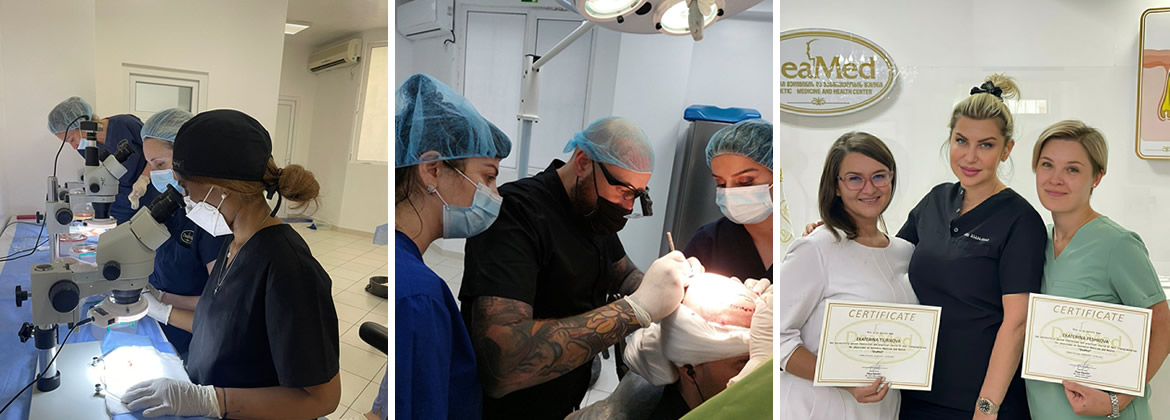
During the Basic Course, trainee doctors acquire fundamental knowledge using educational materials and practical case materials. Lectures are followed by interactive discussions, during which students can ask questions to the instructor and also have the opportunity to practice on a simulator.
Throughout the entire training period, students directly observe the procedures specified in the training course.
The goal of the BASIC TRAINING is a fundamental study of the theoretical material, all stages of transplantation, and the technical and financial components for creating and managing a specialized clinic. A student who has completed the BASIC COURSE can subsequently choose various practical training modules, which also take place in our clinic.
Day I
1. Lecture by the clinic head, Diana Papaskiri; introduction to the clinic.
2. Work in the consultation room (consulting physician – Dr Ekaterina Todua).
3. Patient consultation (medical history, determination of the degree of baldness, assessment of donor resources, selection of contour design, surgery planning, determination of the number of grafts).
4. In the operating room – observation of the stages of the operation.
Day II
1. Preparing the patient for surgery, discussion of the planned operation, creation of the hairline design, shaving. Preparation of the operating room.
2. Lecture by the plastic surgeon: hair transplantation, its indications and contraindications, methods of transplantation, comparison of methods. Non-standard transplantation options: long hair transplantation, body hair transplantation, transplantation into scar areas, restoration of eyebrows, beard, and mustache.
3. Observation of the operation – harvesting grafts from the donor area, preparing grafts under a stereomicroscope.
Day III
1. Preparing the patient for surgery, discussion of the planned operation, creation of the hairline design.
2. Postoperative appointment – care: hair washing, plasma therapy – transplant surgeon Dr Marika Lomia.
3. Observation of the operation – preparing the recipient area, forming micro-incisions. Transplantation of grafts with forceps.
4. Work on the simulator – making incisions, implanting grafts
We will teach you not only the latest methods and technologies of hair transplantation, but also how to equip your own hair transplantation clinic with the newest instruments and equipment.
Course hours
Mon - Fri: 09:00 - 18:00
Sat - Sun: 11:00 - 16:00
Address
Tbilisi
DeaMed Clinic